 English
 اردو
اردو
The Hidden Life of Soil
The Living World Beneath Our Feet
Thought to Ponder
"The most valuable life on a farm is the life we cannot see."
Introduction
Every loaf of bread, every bowl of rice, every fruit and every vegetable begins its journey beneath our feet.
When we look across a field, we notice the green crops, colourful flowers or ripening fruit. Rarely do we think about the ground that supports them. To most people, soil is simply dirt—a mixture of sand, clay and stones that holds plants upright.
Nothing could be further from the truth.
Healthy soil is alive.
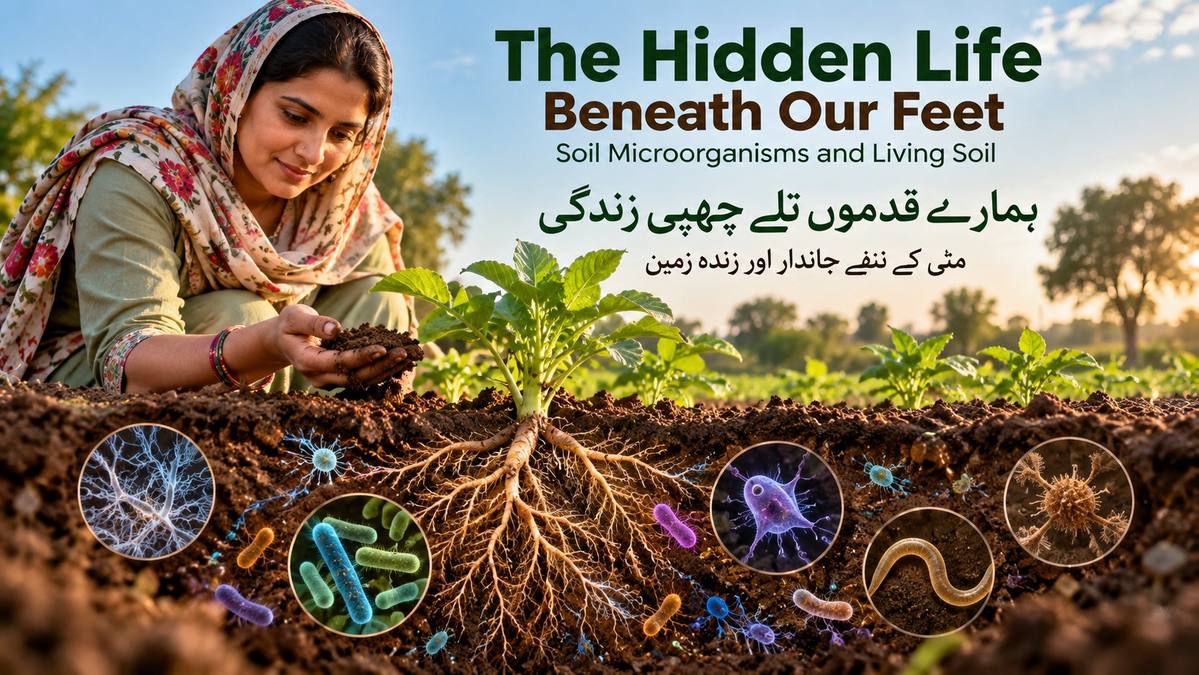
Beneath every healthy field exists an extraordinary community of living organisms working together in perfect harmony. Although invisible to the naked eye, these organisms continuously recycle nutrients, improve soil structure, store water and create the conditions that allow plants to grow.
Without this hidden world, agriculture would not exist.
Understanding the life beneath our feet is the first step towards understanding nature itself.
Soil Is More Than Dirt
Imagine picking up a handful of healthy soil.
It may appear ordinary, but within that handful lives one of the most diverse communities found anywhere on Earth.
Healthy soil is made up of minerals, water, air, organic matter and billions of living organisms. Each part depends upon the others.
The mineral particles provide structure.
Water dissolves and carries nutrients.
Air supplies oxygen to plant roots and soil organisms.
Organic matter provides food and energy.
Living organisms keep the entire system functioning.
Unlike a machine powered by electricity or fuel, soil is powered by life.
Every organism, regardless of its size, performs a specific task. Together they create a balanced ecosystem capable of supporting forests, grasslands, farms and gardens year after year.
Nature's Underground Workforce
If we could shrink ourselves to the size of a grain of sand, the quiet ground beneath our feet would suddenly become a busy city.
Millions of living creatures would be moving through tiny spaces, each performing work essential for healthy soil.
Bacteria – Nature's Recyclers
Bacteria are among the smallest organisms in the soil, yet they are among the busiest.
Their primary responsibility is recycling.
Dead leaves, crop residues, fallen branches and animal waste are gradually broken down into simple nutrients that plants can absorb through their roots.
Some bacteria perform another remarkable task. They capture nitrogen from the atmosphere and convert it into forms that plants can use naturally, enriching the soil and supporting plant growth.
Without bacteria, nature's recycling system would come to a halt.
Fungi – Building Underground Connections
Hidden beneath the surface are delicate fungal threads stretching through the soil.
Many fungi form close partnerships with plant roots. They help plants absorb water and nutrients from areas that roots alone cannot reach.
In return, plants provide the fungi with sugars produced during photosynthesis.
This partnership benefits both.
It is one of the finest examples of cooperation found in nature.
Earthworms – Nature's Engineers
Among all the creatures living in soil, earthworms are perhaps the easiest to recognise.
Their importance, however, is often underestimated.
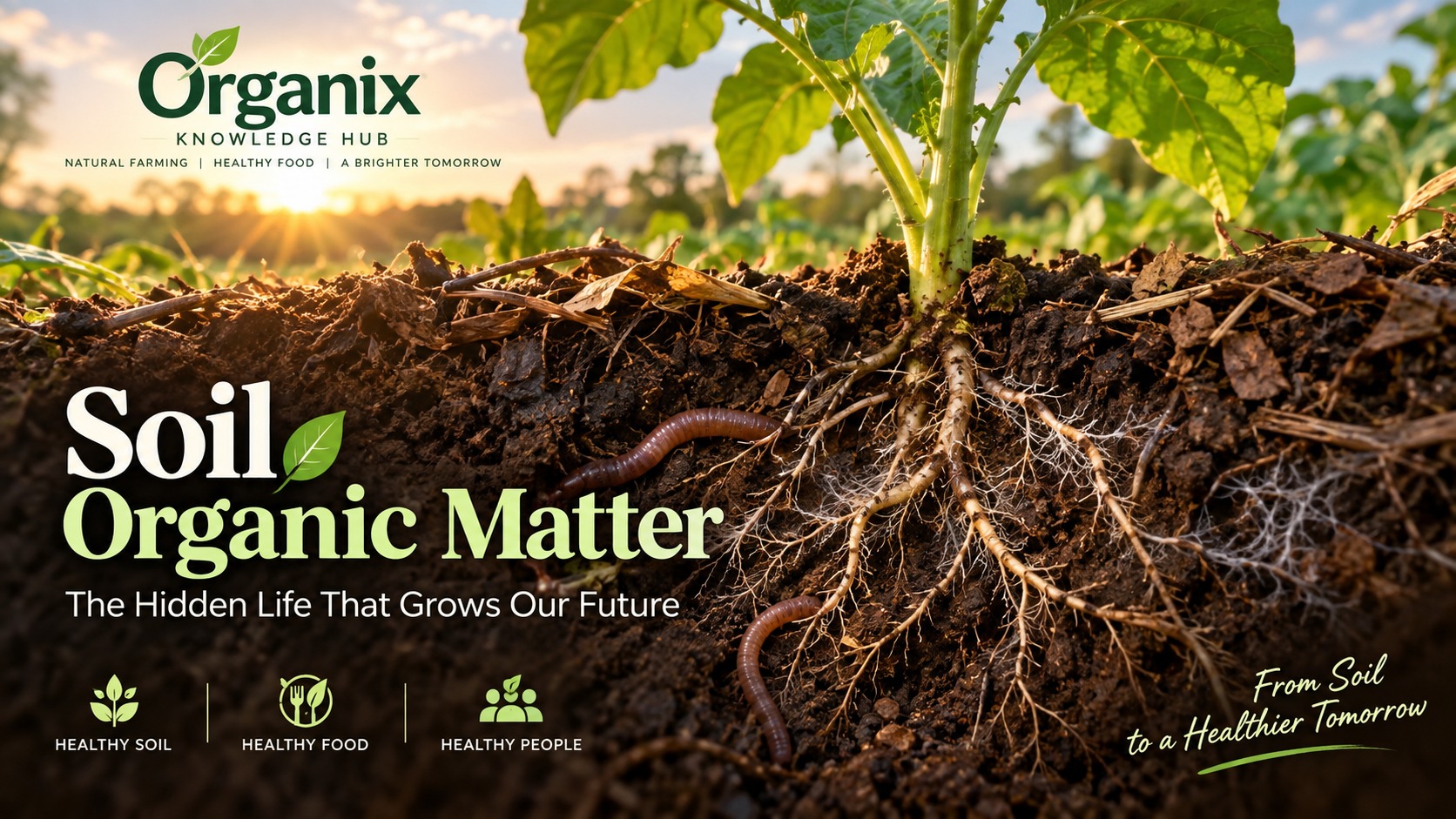
As earthworms move through the soil, they create tunnels that allow rainwater to soak deep into the ground instead of running across the surface.
These tunnels also improve the movement of air, helping roots grow deeper and healthier.
While feeding on organic matter, earthworms produce nutrient-rich castings that naturally improve soil fertility.
Different groups of earthworms perform different functions. Some live among fallen leaves, others mix organic matter into the upper layers of soil, while deep-burrowing species create permanent channels that improve drainage and provide pathways for plant roots.
Their work continues every day of the year without fuel, machinery or human assistance.
Pakistan is home to a variety of native earthworm species adapted to different soils and climates. These natural soil engineers play an important role in maintaining soil fertility and structure. Understanding their ecology and encouraging healthy populations will help farmers work with nature rather than against it—a topic we will explore in a future Knowledge Paper.
Countless Other Helpers
Earthworms do not work alone.
Healthy soil is also home to beetles, ants, mites, termites, springtails, protozoa, nematodes and many other organisms.
Some break large pieces of organic matter into smaller fragments.
Others feed on bacteria and fungi, releasing nutrients that plants can use.
Predators help maintain balance by controlling the populations of other organisms.
Each species performs a different task, yet together they create one of nature's most efficient ecosystems.
Nature Never Wastes Anything
Walk through a woodland after autumn or visit an undisturbed forest.
The ground is covered with fallen leaves, twigs and dead plants.
Yet the forest floor never becomes buried beneath endless layers of waste.
Why?
Because nature has perfected recycling.
The moment a leaf falls to the ground, countless organisms begin breaking it down.
Earthworms pull it into the soil.
Fungi digest tough fibres.
Bacteria complete the recycling process.
The nutrients released become food for the next generation of plants.
Nothing is wasted.
Everything is reused.
This natural cycle has sustained life on Earth for millions of years.
Healthy Soil Produces Healthy Plants
Healthy soil does much more than support plant roots.
It stores water like a sponge.
It supplies nutrients gradually as plants need them.
It allows roots to grow deeper.
It helps plants withstand periods of drought.
It supports beneficial organisms that naturally suppress some plant diseases.
For a farmer, healthy soil means healthier crops.
For a nation, healthy soil means greater food security.
Every improvement made to soil today benefits future harvests.
When Soil Loses Its Life
Healthy soil can be damaged when its natural balance is disturbed.
Repeated disturbance, erosion, loss of organic matter and poor land management gradually reduce the number and diversity of beneficial organisms.
As soil life declines, its structure begins to deteriorate.
Water no longer soaks into the ground as efficiently.
Organic matter disappears.
The soil becomes compacted.
Plant roots struggle to grow.
Crop productivity often declines while dependence on fertilizers and irrigation increases.
Although the surface may still appear normal, the living ecosystem beneath it has been weakened.
Beyond Fertilizers: Feeding the Soil, Not Just the Crop
Modern fertilizers have played an important role in increasing agricultural production. They provide essential nutrients that crops need, and when used carefully they can help farmers achieve better yields.
However, healthy agriculture depends on more than supplying nutrients to plants.
A plant does not grow in isolation. It grows in a living soil ecosystem where organic matter, microorganisms, fungi, earthworms and countless other organisms work together to release nutrients, improve soil structure and maintain water balance.
Chemical fertilizers provide nutrients directly to crops, but they do not replace the natural processes that keep soil alive. If the organic matter in soil continues to decline and soil life becomes weaker, farmers may need increasing amounts of external inputs to maintain production.
Nature shows us another approach.
For thousands of years, forests and natural ecosystems have maintained their fertility through the continuous recycling of leaves, plant residues and organic matter. Nothing is wasted. Every fallen leaf becomes food for the next generation of plants.
Organic fertilizers such as compost, farmyard manure, green manure and decomposed plant residues follow the same natural principle. They do not simply provide nutrients; they also rebuild soil organic matter, encourage beneficial organisms and improve the long-term health of the land.
The future of sustainable agriculture is not about choosing between science and nature. It is about using knowledge to work with natural processes.
Healthy crops begin with healthy soil. When we feed the soil, the soil has the ability to feed the world.
Learning from Nature
Long before people began farming, nature had already perfected the art of building healthy soil.
Forests are never ploughed.
Grasslands are never cultivated.
Yet they continue to support abundant plant life year after year.
Nature protects the soil with leaves and vegetation.
Organic matter is continuously returned to the land.
Earthworms, fungi, insects and microorganisms recycle nutrients and improve soil structure without human intervention.
Modern sustainable farming increasingly learns from these natural processes by protecting soil life, returning organic matter to the land and reducing unnecessary disturbance.
Nature has always been our greatest teacher.
Why Soil Matters to Pakistan
Agriculture is one of Pakistan's greatest strengths.
It provides food, employment and livelihoods for millions of people.
Whether growing wheat in Punjab, rice in Sindh, fruit in Balochistan or vegetables across the country, every farmer depends upon healthy soil.
Yet many agricultural regions are facing increasing challenges, including declining organic matter, water scarcity, erosion and salinity.
Protecting soil is therefore not only an environmental responsibility but also an economic necessity.
Healthy soils conserve water, improve crop resilience, reduce production costs and strengthen food security.
Investing in soil is investing in Pakistan's future.
Conclusion
The next time you walk across a field or work in your garden, pause for a moment.
Beneath your feet lies a living world that few people ever see.
Billions of tiny organisms are working silently together—building soil, recycling nutrients, storing water and supporting every plant that feeds humanity.
Healthy soil cannot be created overnight.
It is built slowly through countless natural processes working together in perfect balance.
Our responsibility is simple.
To understand this hidden world.
To protect it.
And to leave it healthier for the generations that follow.
Because the future of agriculture does not begin with seeds.
It begins with living soil.
Key Takeaways
- Soil is a living ecosystem, not merely dirt.
- Billions of organisms work together to maintain healthy soil.
- Bacteria recycle nutrients, fungi build partnerships with plants and earthworms improve soil structure.
- Healthy soil stores more water, supports stronger plants and produces better harvests.
- Nature has sustained fertile soils for millions of years through continuous recycling of organic matter.
- Protecting soil health is essential for Pakistan's food security and sustainable agriculture.
- Every healthy harvest begins with healthy living soil.
Organix Insight: When we care for the life beneath our feet, the life above it flourishes.
References and Further Reading
Brady, N. C., & Weil, R. R. (2017). The Nature and Properties of Soils (15th ed.). Pearson.
Doran, J. W., & Zeiss, M. R. (2000). Soil health and sustainability: Managing the biotic component of soil quality. Applied Soil Ecology, 15(1), 3–11.
Food and Agriculture Organization of the United Nations. (2015). Status of the World's Soil Resources (SWSR) – Main Report. FAO.
Food and Agriculture Organization of the United Nations. (2017). Voluntary Guidelines for Sustainable Soil Management. FAO.
United States Department of Agriculture, Natural Resources Conservation Service. (2000). Soil Biology Primer. USDA.
Pakistan Agricultural Research Council. Publications on Soil Fertility and Sustainable Agriculture. Islamabad, Pakistan.
About Organix Knowledge Hub
The Organix Knowledge Hub shares reliable, science-based knowledge to promote sustainable agriculture, environmental conservation and informed living.
Learn from Nature. Grow with Nature.
nter your content here...