 English
 اردو
اردو
"Nature has been farming successfully for millions of years. Our greatest opportunity is to understand how."
Introduction
Every successful harvest begins long before a seed is planted.
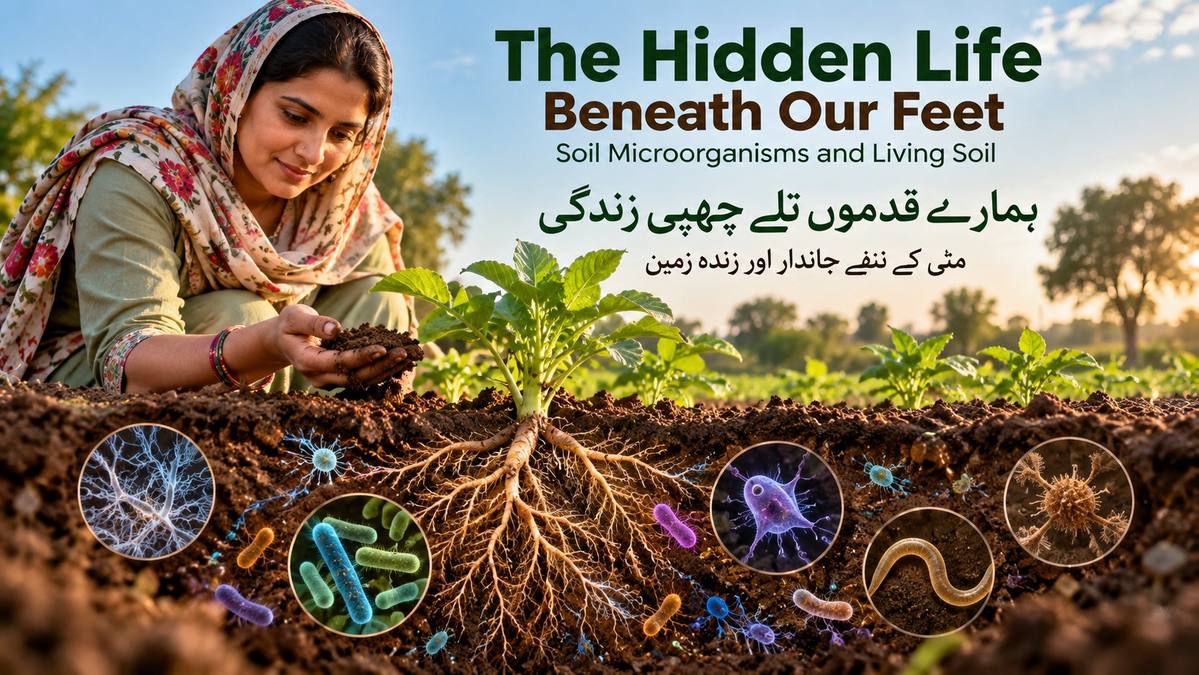
Beneath every healthy field lies an invisible world where billions of living organisms work tirelessly, recycling nutrients, improving soil structure, and creating the conditions that allow plants to grow. In our previous paper, The Hidden Life of Soil, we explored this extraordinary underground community and discovered that healthy soil is one of the most diverse ecosystems on Earth.
But every living community depends on a source of nourishment.
What keeps this hidden world alive?
The answer is Soil Organic Matter (SOM).
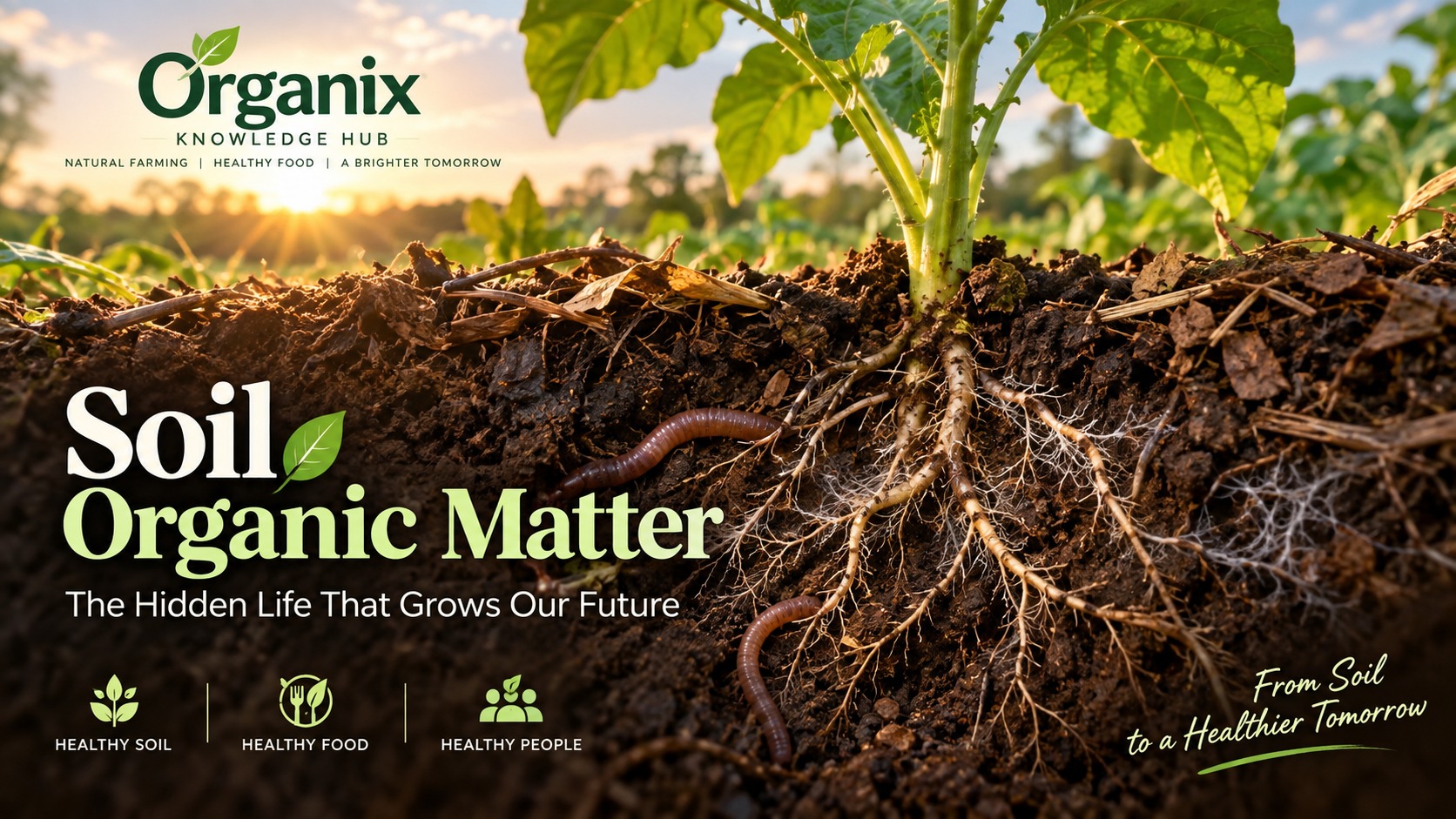
Although it usually represents only a small percentage of the soil, Soil Organic Matter is the foundation of healthy agriculture. It is the fuel that powers the hidden life beneath our feet, the natural storehouse of nutrients, and the engine that drives nature's continuous cycle of renewal.
For millions of years, forests, grasslands, and natural ecosystems have remained productive because of this remarkable process. Long before humans cultivated crops or manufactured fertilizers, nature had already perfected a system that recycled every fallen leaf, every dead root, and every living organism into fertile soil.
Understanding Soil Organic Matter is therefore not simply about understanding soil—it is about understanding how nature has sustained life on Earth for millions of years.
Nature Never Produces Waste
Imagine walking through a mature forest.
The ground is covered with fallen leaves, broken branches, decaying wood, animal droppings, and the remains of plants that completed their life cycle many years ago.
At first glance, it appears untidy.
To nature, it is priceless.
Every fallen leaf is another investment in tomorrow's forest.
Every dead root becomes food for life beneath the soil.
Every fallen tree eventually nourishes new generations of plants.
Nothing is wasted.
Everything is recycled.
Nature has no rubbish bins because nature produces no rubbish.
Instead, it operates the largest recycling system on Earth.
The same principle applies to agricultural land.
Crop residues left after harvest, roots remaining beneath the soil, farmyard manure, compost, green manures, and even the remains of microscopic organisms all become part of a continuous cycle that builds and maintains fertile soil.
Together, these materials form what scientists call Soil Organic Matter.
It is far more than decomposed plant material.
It is nature's way of returning life to the soil so that the soil can continue supporting new life.
Nature's Nutrient Bank
Imagine that every field has its own bank.
Instead of storing money, this bank stores fertility.
Every time crop residues are returned to the field...
Every time compost is added...
Every application of well-decomposed farmyard manure...
Every cover crop grown and incorporated into the soil...
Every fallen leaf...
Every dying root...
becomes another deposit into what we might call Nature's Nutrient Bank.
These deposits contain valuable nutrients, including nitrogen, phosphorus, potassium, calcium, magnesium, sulphur, and many essential micronutrients.
Unlike a financial institution, however, Nature's Nutrient Bank does not simply store wealth.
It continuously transforms it.
As organic materials decompose, nutrients are released slowly and naturally, becoming available when plants need them. At the same time, part of the organic material is converted into more stable forms that continue enriching the soil for many years.
The larger the deposits, the richer the soil becomes.
Just as a healthy financial account provides security during difficult times, a soil rich in organic matter provides resilience during drought, heavy rainfall, and other environmental stresses. It also supports healthier biological activity and improves the soil's ability to make efficient use of nutrients.
A wise farmer understands that long-term prosperity depends not only on this season's harvest, but also on the health of the land that will produce future harvests.
Nature follows exactly the same principle.
The Bank Managers
Every bank needs people to manage its wealth.
Nature has billions.
The bacteria, fungi, earthworms, insects, and countless microscopic organisms living beneath the soil are the managers of Nature's Nutrient Bank.
Every day they perform tasks that no machine can replicate.
They break down crop residues.
They decompose animal manure.
They recycle dead roots.
They convert complex organic materials into simpler compounds.
They gradually release nutrients that plants can absorb.
They create tiny channels that allow air and water to move through the soil.
They bind soil particles together, improving structure and reducing erosion.
They help build humus, one of the most valuable long-term components of fertile soil.
This remarkable workforce operates continuously, without wages, without supervision, and without producing waste.
Yet even this workforce depends on one essential resource.
Food.
Their food is Soil Organic Matter.
When fresh organic material is regularly returned to the soil, this hidden community flourishes.
When organic matter is continually removed or burned without replacement, the underground workforce gradually loses its source of nourishment. Biological activity declines, nature's recycling system slows, and the soil begins to lose part of its natural fertility.
A bank cannot grow without regular deposits.
Neither can the living soil.
Nature's Long-Term Vision
Plants require nutrients such as nitrogen, phosphorus, and potassium to grow. Modern agriculture has helped farmers increase food production by supplying these essential nutrients, contributing significantly to global food security.
Nature provides these same nutrients.
But it follows a different philosophy.
Nature does not work for a single growing season.
Nature works for generations.
Rather than simply supplying nutrients to today's crop, nature continually invests in the health of the soil itself. Every fallen leaf, every dead root, every animal dropping, and every piece of decaying organic matter becomes part of a long-term investment that strengthens the soil year after year.
As billions of microorganisms recycle this organic matter, nutrients are released gradually, humus is formed, soil structure improves, and the underground ecosystem continues to thrive.
The result is far greater than plant nutrition alone.
Nature builds a living soil capable of nourishing crops not only today, but for generations to come.
Perhaps this is nature's greatest lesson for agriculture.
Instead of asking,
"How can we maximize this season's harvest?"
Nature asks,
"How can we leave the soil healthier for the next generation?"
That long-term vision has sustained forests, grasslands, and natural ecosystems for millions of years.
It remains just as relevant to agriculture today.
From Organic Matter to Humus
Every deposit into Nature's Nutrient Bank follows its own journey.
Fresh leaves, crop residues, roots, animal manure and other organic materials do not become humus overnight.
The moment these materials enter the soil, nature's recycling workforce begins its task.
Bacteria and fungi are the first to attack the softer plant tissues, using them as food and energy. Earthworms and other soil organisms break larger materials into smaller pieces, allowing microorganisms to continue the process more efficiently.
The easily decomposed materials, including natural sugars, proteins and other simple compounds, disappear first. As they decompose, valuable nutrients such as nitrogen, phosphorus and potassium are gradually released back into the soil, where growing plants can absorb them.
The tougher materials take much longer.
Natural compounds such as cellulose and lignin—the substances that give plants and trees their strength—resist rapid decomposition. Only specialised microorganisms and fungi can slowly transform these resistant materials through years of biological activity.
Eventually, the most stable portion becomes humus.
Humus is not simply old leaves or well-rotted compost.
It is an entirely new substance created through countless biological and chemical transformations. Rich in stable carbon compounds, humus remains in the soil for many years, sometimes even decades.
It acts as a long-term reserve of nutrients, improves soil structure, supports biological life, stores carbon and helps the soil remain productive for future generations.
If fresh organic matter is nature's daily income, humus is nature's long-term savings.
In our next paper we shall discover how composting can help farmers accelerate this remarkable natural process.
Learning from Nature
One of nature's greatest lessons is patience.
A fertile forest is not created in one year.
Nor is healthy farmland.
Season after season, nature quietly returns organic materials to the soil. Every growing cycle adds a little more than the previous one, slowly building fertility over decades and centuries.
Nature never mines the soil.
Nature continually reinvests in it.
That is why forests remain productive generation after generation without fertilizer factories or waste disposal systems.
Agriculture can learn from the same principle.
Returning crop residues to the land, preparing compost, applying well-decomposed farmyard manure and protecting the soil surface are not simply farming practices.
They are regular deposits into Nature's Nutrient Bank.
Each deposit strengthens the living soil that will nourish future harvests.
A Lesson for Pakistan
Pakistan's farmers have always worked hard to produce food under challenging conditions. Today they face rising production costs, increasing temperatures, irregular rainfall and growing pressure on limited water resources.
Many agricultural soils in Pakistan also contain relatively low levels of Soil Organic Matter.
Over many years, crop residues have often been removed or burned, while insufficient organic material has been returned to replace what nature has lost.
As a result, the soil's natural nutrient bank gradually becomes depleted.
This presents both a challenge and an opportunity.
Every season, farmers invest significant amounts of money in fertilizers to supply crops with essential nutrients. These nutrients remain indispensable for crop production. However, nature reminds us that nutrients alone cannot maintain a healthy, living soil.
Many farms already possess valuable organic resources.
Farmyard manure.
Cattle dung.
Poultry litter.
Crop residues.
Fruit and vegetable waste.
These are often regarded simply as waste materials, yet they represent valuable natural assets. In many farming communities, these resources are readily available on the farm or from nearby dairy and livestock operations. Apart from collection, transportation and proper composting, they require little additional financial investment.
When these materials are returned to the land, farmers are doing far more than applying organic fertilizer.
They are feeding the billions of organisms that recycle nutrients.
They are rebuilding soil structure.
They are increasing the soil's natural ability to make efficient use of available nutrients.
They are investing in healthier land for future generations.
Over time, healthy soils become more productive, more resilient and more economical to manage.
The greatest return on this investment may not come in a single season.
It comes through healthier soils that continue supporting profitable farming for many years.
Working With Nature
Nature has spent millions of years perfecting the art of building fertile soil.
Plants capture energy from sunlight.
Animals return nutrients to the land.
Microorganisms recycle organic matter.
Earthworms improve the soil.
Fungi transport nutrients.
Every organism performs a role.
Nothing is wasted.
Everything contributes.
Healthy agriculture succeeds when it works alongside these natural processes.
Instead of viewing organic matter as a waste product, we can recognise it as one of the farm's most valuable resources.
Instead of asking only,
"How much fertilizer should I apply?"
we can also ask,
"How much organic matter have I returned to my soil this year?"
That single question can transform the way we think about farming.
Conclusion
Healthy soil is not created by chance.
It is built patiently, season after season, through nature's continuous cycle of renewal.
Every fallen leaf.
Every crop residue.
Every dead root.
Every handful of compost.
Every load of well-managed farmyard manure.
Every piece of organic matter becomes another deposit into Nature's Nutrient Bank.
Hidden beneath the surface, billions of living organisms transform these deposits into fertile soil, ensuring that nutrients continue nourishing new generations of plants.
Nature has followed this strategy for millions of years.
Its vision has never been limited to a single harvest.
Nature always thinks beyond the present season.
It continually builds healthier soil for the future.
Perhaps that is agriculture's greatest lesson.
Do not think only about feeding today's crop.
Build tomorrow's soil.
When we invest in the soil, the soil rewards us with healthier crops, healthier farms and a healthier future.
Nature's Lesson
A farmer's greatest asset is not the fertilizer he buys each season, but the fertility he builds and leaves behind. Every handful of organic matter returned to the soil is a deposit into Nature's Nutrient Bank—an investment that strengthens the land, supports life beneath our feet, improves farm profitability and safeguards food production for generations to come.