 English
 اردو
اردو

How Nature Turns Waste into Fertility
Thought to Ponder
“In nature, what appears to be waste is often the beginning of new life.”
Introduction
Walk through a forest and look at the ground.
Leaves fall. Branches break. Plants die. Animals leave behind waste. Yet no one removes these materials or brings fertilizer to replace what has been lost.
Still, the forest continues to grow.
Nature has its own recycling system. Bacteria, fungi, insects and other organisms gradually break down dead organic material and return its nutrients to the soil. What supported one generation of life eventually helps support the next.
Composting follows the same principle.
By bringing suitable organic materials together and providing the right conditions for decomposition, we can turn crop residues, manure, leaves and other biodegradable materials into something valuable for the soil.
We provide the materials and the right environment. Nature does the rest.
What Is Compost?
Compost is organic material that has been broken down through biological activity into a dark, crumbly, soil-like material.
It can be produced from materials commonly available around farms, gardens and homes, such as:
- crop residues
- dry leaves and straw
- grass and plant cuttings
- weeds before they produce seed
- fruit and vegetable waste
- animal manure
- other suitable biodegradable plant material
But a heap of organic waste is not necessarily compost.
Good composting is a controlled biological process. The microorganisms responsible for decomposition need the right balance of food, moisture and oxygen.
When we understand these basic requirements, composting becomes surprisingly simple.
The Workers Inside a Compost Pile
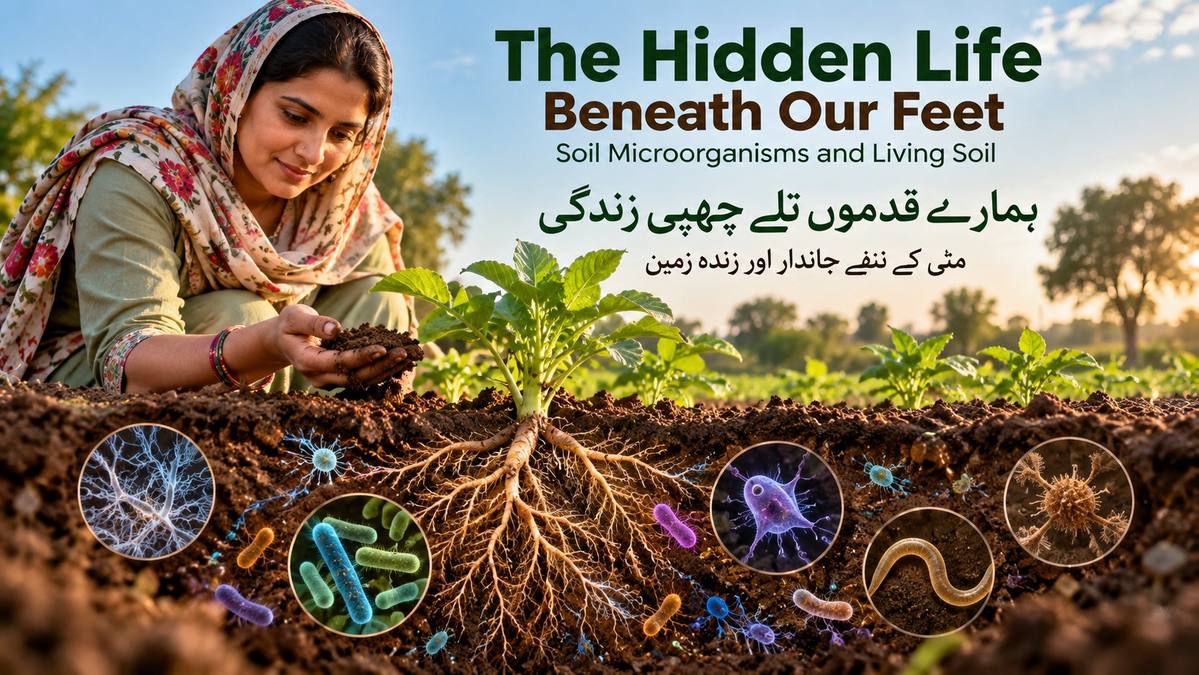
A compost pile may appear quiet from the outside. Inside, however, millions of organisms can be at work.
Bacteria begin breaking down softer and easily decomposed materials. Fungi help decompose tougher plant fibres. Other microscopic organisms join the process, while insects and other small creatures help break larger pieces into smaller ones.
These organisms are simply following the natural roles for which they were created—feeding, growing and completing their life cycles. Yet together, by Allah's design, their countless individual activities form a remarkable and continuous system of recycling that sustains life.
The result of their activity is decomposition.
This is the same biological workforce that operates continuously in healthy soil. Composting simply brings suitable materials together so that this natural process can occur efficiently.
Green and Brown: Feeding the Compost Workers
The organisms making compost need both nitrogen and carbon.
Fresh, moist materials such as green leaves, grass clippings, vegetable waste and many animal manures are generally richer in nitrogen. These are often called green materials.
Dry materials such as fallen leaves, straw, dried crop residues and small woody material contain proportionately more carbon. These are commonly called brown materials.
Nitrogen helps microorganisms grow and reproduce. Carbon provides much of the energy they need.
Too much wet, nitrogen-rich material can produce a dense, unpleasant-smelling pile. Too much dry, carbon-rich material can make decomposition very slow.
The answer is balance.
For ordinary farm and home composting, there is usually no need to measure every ingredient precisely. Mixing a variety of green and brown materials gives nature much of what it needs.
A Little More Science: The Carbon–Nitrogen Balance
Scientists describe this balance through the carbon-to-nitrogen ratio, usually written as C:N.
Microorganisms use carbon primarily for energy and nitrogen for growth, proteins and reproduction. For efficient composting, a starting C:N ratio of approximately 25:1 to 30:1 provides favourable conditions, although a somewhat wider range can also compost successfully.
This means roughly 25–30 parts carbon for every one part nitrogen by weight. It does not mean mixing 25 buckets of brown material with one bucket of green material, because every ingredient already contains both carbon and nitrogen in different proportions.
If the C:N ratio is too high—too much carbon relative to nitrogen—microbial growth is restricted and decomposition becomes slow.
If the ratio is too low—too much nitrogen—some nitrogen may be lost as ammonia, often accompanied by an unpleasant smell.
For farmers and home gardeners, the practical lesson remains simple:
Use a mixture of nitrogen-rich green materials and carbon-rich brown materials, and observe how the pile responds.
The science explains why the balance matters; experience helps us achieve it.
Compost Needs Water—and Air
Like most living things, composting microorganisms need water.
If the material becomes completely dry, biological activity slows considerably. If it becomes waterlogged, however, water fills spaces that should contain air.
Oxygen is equally important.
A healthy compost pile should therefore be moist but not soaked. The material should feel damp rather than dripping wet.
Turning or loosening the pile periodically allows fresh air to enter. Mixing coarse and fine materials also helps maintain spaces through which oxygen can move.
When a compost pile develops a strong rotten smell, it is often telling us something: the balance of moisture, air or materials needs attention.
The compost itself becomes a useful guide if we learn to observe it.
Why Does Compost Heat Up?
An active compost pile can become surprisingly warm.
The heat does not come from the sun. It is generated largely by microorganisms as they consume and break down organic material.
When sufficient food, moisture and oxygen are available, microbial activity increases and the temperature inside the pile rises.
This natural heating is useful. Under properly managed conditions, sufficiently high temperatures can help destroy many weed seeds and reduce some disease-causing organisms.
As the easily decomposed materials are consumed, activity gradually slows and the pile begins to cool.
The compost is moving towards maturity.
Making Compost — The Basic Method
Making compost does not necessarily require complicated equipment. The principle is to bring suitable materials together while maintaining moisture and air.
1. Choose a suitable place.
Select a reasonably shaded, well-drained location where the compost can remain while decomposition takes place.
2. Collect different materials.
Bring together nitrogen-rich green materials and carbon-rich brown materials.
3. Reduce large pieces where practical.
Cutting or breaking large crop residues into smaller pieces increases the surface available to microorganisms and generally speeds decomposition.
4. Build the pile.
Mix or alternate green and brown materials rather than creating one thick layer of a single material.
5. Add moisture.
Keep the pile damp throughout, but avoid soaking it.
6. Allow air to enter.
Turn or loosen the material periodically so that oxygen continues to reach the microorganisms.
7. Observe what is happening.
Heat indicates active decomposition. Excessive wetness, strong unpleasant smells or very slow decomposition may indicate that the balance needs adjustment.
8. Allow the compost to mature.
Give nature time to complete the process.
The exact time required varies with the materials, climate, moisture, pile size and frequency of turning. Compost is therefore better judged by its condition than by the calendar alone.
How Do We Know When Compost Is Ready?
Finished compost should look very different from the materials with which we started.
Leaves, vegetable waste and other ingredients become difficult to recognise. The volume of the pile decreases and its colour becomes darker.
Mature compost generally has:
- a dark colour
- a loose, crumbly texture
- an earthy smell
- little resemblance to the original ingredients
- no excessive heat in the centre of the pile
Patience matters.
Applying poorly decomposed material too early can allow active decomposition to continue in the soil and may temporarily compete with plants for available nitrogen. Mature compost is therefore preferable for most direct applications around crops.
What Does Compost Give Back to the Soil?
The value of compost cannot be judged only by how much nitrogen, phosphorus or potassium it contains.
Its contribution is much broader.
Compost returns organic matter to the land. That organic matter feeds soil organisms and contributes to the natural processes explored in our previous Knowledge Papers.
With regular use, good-quality compost can help:
- improve soil structure
- increase water infiltration
- improve moisture retention
- support beneficial soil organisms
- gradually return plant nutrients
- improve the soil's ability to retain nutrients
- reduce the tendency of some soils to become hard and compacted
This is an important distinction.
Mineral fertilizers can supply specific nutrients to a crop. Compost contributes nutrients too, but it also helps rebuild the living environment in which the crop grows.
Compost should therefore not be viewed simply as another fertilizer.
It is a soil-building material.
Turning Farm Resources Back into Fertility
A farmer may already possess many of the ingredients needed for compost.
After harvesting, crop residues remain. Livestock produce manure. Trees shed leaves. Vegetable farms and markets generate plant waste.
These materials contain carbon and nutrients that originally came from soil, plants and sunlight.
When suitable residues are burned or discarded, much of that potential resource is lost. When they are properly composted and returned to the land, part of the natural fertility cycle is restored.
Composting is not completely free. Collecting materials, building and turning piles, managing moisture and transporting finished compost require labour and sometimes equipment.
But where raw materials are locally available, farmers can convert materials of little apparent value into a useful soil resource.
That has both environmental and economic value.
Compost and Pakistan
Composting has particular relevance for Pakistan.
Our farms, livestock operations, fruit and vegetable markets, gardens and households generate large quantities of biodegradable organic material. At the same time, many agricultural soils in Pakistan contain relatively low levels of organic matter.
These two problems can become part of the same solution.
Farmyard manure can be managed more effectively. Suitable crop residues can be returned to the soil rather than burned. Vegetable and fruit waste can be separated from plastics and other rubbish and converted into useful compost.
For small farmers, orchards, nurseries, vegetable growers and home gardeners, composting can be carried out at different scales according to the materials, space and labour available.
It also offers a simple economic principle:
Before buying something for the soil, first look at what the farm is already throwing away.
Not every external input can be replaced by compost, and the nutrient requirements of crops still need to be understood. But recycling locally available organic resources can reduce waste while gradually rebuilding the soil on which future production depends.
What Should Stay Out of the Compost Pile?
Good compost begins with clean ingredients.
Plastics, glass, metals, batteries and other non-biodegradable waste should never enter agricultural compost.
Materials contaminated with harmful chemicals should also be avoided.
Diseased plants and weeds carrying mature seeds require particular care because poorly managed compost may not become hot enough to destroy all pathogens or seeds.
For simple household and farm compost piles, meat, fats and oily food waste can also create odours and attract animals.
A useful rule is:
If we would not want a contaminant in our soil, we should not put it into our compost.
A Cycle Completed
A crop begins in the soil.
It takes water and nutrients, captures sunlight, grows and eventually produces food.
After harvest, part of that plant remains behind. Other organic materials are produced around the farm.
Composting gives us a way to return some of this material to where the cycle began.
Residues become food for microorganisms.
Microorganisms transform them into compost.
Compost returns organic matter and nutrients to the soil.
And the soil supports another crop.
What appears to be the end of one harvest can therefore become the beginning of another.
Conclusion
Composting is neither mysterious nor new.
Long before agriculture existed, nature was already recycling dead plants and organic materials into fertile soil.
We have simply learned to manage that process.
By combining suitable organic materials with moisture, air and time, farmers and gardeners can allow nature's smallest workers to transform residues into a valuable soil-building resource.
For Pakistan, where organic resources are abundant but many soils are poor in organic matter, compost represents an opportunity that deserves greater attention.
The lesson is simple:
Do not ask only how to dispose of organic waste. Ask how much of it can safely be returned to the cycle of life.
Key Takeaways
- Composting is a managed form of natural biological decomposition.
- Microorganisms perform most of the work; we provide suitable materials and conditions.
- Carbon-rich and nitrogen-rich materials both have important roles.
- A starting C:N ratio around 25:1–30:1 favours active decomposition, but farmers can achieve practical balance by combining green and brown materials.
- Successful composting requires moisture and oxygen as well as organic material.
- Heat inside an active pile is produced by microbial activity.
- Mature compost is dark, crumbly, earthy-smelling and bears little resemblance to its original ingredients.
- Compost supplies some nutrients, but its greater value lies in returning organic matter and supporting living soil.
- Locally available crop residues, manure and plant waste can become valuable agricultural resources.
- Composting has particular potential in Pakistan because it can address organic waste and declining soil organic matter together.
Organix Insight
In nature, the end of one life becomes the beginning of another. Compost simply helps complete the cycle.
References and Further Reading
- Cornell University, Cornell Composting — resources on compost chemistry, carbon-to-nitrogen balance and compost management.
- United States Department of Agriculture, Natural Resources Conservation Service — guidance on composting, organic materials and soil management.
- United States Department of Agriculture, Agricultural Marketing Service — guidance on compost and organic crop production.
- Food and Agriculture Organization of the United Nations — resources on composting, soil organic matter and sustainable soil management.
About Organix Knowledge Hub
The Organix Knowledge Hub shares reliable, science-based knowledge to promote sustainable agriculture, environmental conservation and informed living.
Learn from Nature. Grow with Nature.