 English
 اردو
اردو
Who Are the Invisible Workers Beneath Our Feet?
A Thought to Begin With
“Some of the smallest workers on a farm perform some of its biggest jobs.”
The World Beneath Our Feet
A farmer looking across a field sees crops, soil and water. But beneath his feet is another world—one too small to see, yet essential to the fertility and health of the land.
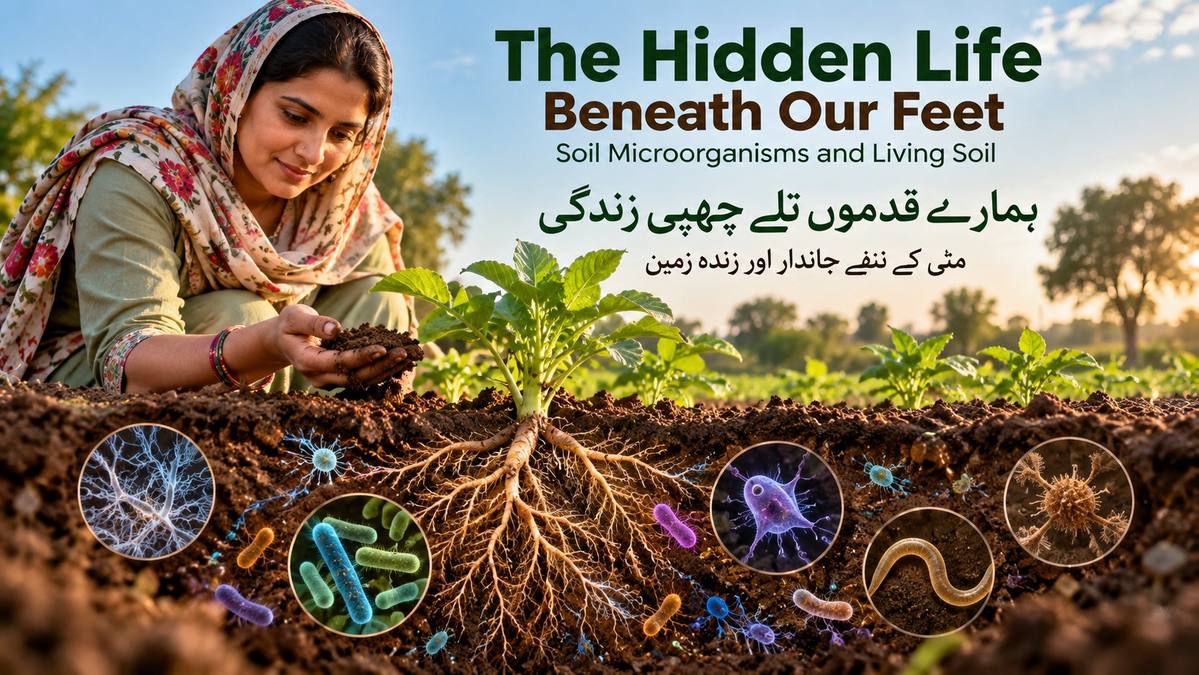
Healthy soil contains enormous communities of bacteria, fungi, actinomycetes, protozoa and other microscopic organisms. Together with larger soil organisms, they form an interconnected Soil Food Web.
Dead plants become food. Organic matter is decomposed. Nutrients are released and recycled. Roots provide carbon compounds to microorganisms, while microorganisms help make nutrients available within the soil system.
This invisible workforce is part of what makes soil alive.
Different Workers, Different Jobs
Bacteria perform many jobs. Some decompose organic matter, while others participate in nutrient cycling. Certain bacteria can convert atmospheric nitrogen into forms that eventually become available to plants, particularly through their association with legumes. Others help transform nutrients such as phosphorus into forms roots can more readily use.
Fungi perform different tasks. Their microscopic threads spread through soil, decomposing tougher plant material and exploring areas beyond the immediate reach of roots.
Among the most important are mycorrhizal fungi, which form partnerships with plants. Their fungal networks help roots obtain water and nutrients from a larger area, while the plant provides the fungi with carbon compounds produced through photosynthesis.
The plant feeds the fungus. The fungus helps the plant.
Actinomycetes help break down resistant organic material and contribute to the familiar earthy smell of healthy soil and mature compost.
Protozoa feed on bacteria and other microorganisms, helping release nutrients back into the soil. Nematodes occupy several levels of the food web—some feed on bacteria and fungi, while others are plant parasites.
This teaches us something important:
Healthy soil does not mean that every organism is beneficial. It means that a diverse biological community is functioning in balance.
Roots Are Not Working Alone
The narrow area around plant roots, known as the rhizosphere, is one of the busiest biological regions in soil.
Plants release sugars and other carbon compounds through their roots, providing food for nearby microorganisms. In return, microbial activity helps cycle nutrients and can support plant health.
Some beneficial microorganisms also compete with disease-causing organisms for food and space. Others can produce substances that inhibit certain pathogens or stimulate the plant’s own defence responses. A healthy biological soil can therefore provide an important natural layer of protection against some plant diseases.
A root does not work alone.
It lives within a biological community.
And the relationship can extend beyond a single plant. Legumes, working with nitrogen-fixing bacteria, can bring additional nitrogen into the farming system. Green-manure and deep-rooted plants can capture nutrients and return them to the upper soil when their biomass decomposes. Carefully selected crops can support beneficial organisms or help interrupt some pest and disease cycles.
In organic agriculture, therefore, one plant can sometimes help feed or protect another by strengthening the natural relationships already present in the farm ecosystem.
That community still needs food. Compost, properly managed manure, crop residues and dead roots provide organic material for soil organisms.
This leads to a fundamental principle of organic agriculture:
Do not think only about feeding the crop. Feed the living soil that helps feed and protect the crop.
What Disturbs This Living System?
Every agricultural practice affects life beneath the soil.
Repeated intensive tillage can disturb fungal networks and accelerate organic matter loss. Bare soil removes living roots that feed microorganisms. Waterlogging reduces oxygen, while severe dryness slows biological activity. Loss of organic matter is particularly damaging because it removes a major source of microbial food.
Pesticides add another concern. They are designed to affect living organisms, but the intended pest may not always be the only organism affected. The impact varies with the product, dose, frequency and soil conditions, so it would be incorrect to claim that every pesticide destroys soil microorganisms.
But non-target effects can occur.
Fungicides illustrate the problem clearly: while they may control disease-causing fungi, soil also contains beneficial fungi, including mycorrhizal fungi associated with plant roots.
Organic agriculture therefore begins with prevention—healthy soil, crop rotation, biodiversity, resistant crops, beneficial organisms and sound farm management—rather than making chemical intervention the first response.
Fertilizers raise a different issue.
Plants need nitrogen, phosphorus, potassium and other mineral nutrients, and synthetic fertilizers can supply them quickly. But:
Feeding the crop is not necessarily the same as feeding the soil.
Repeated or excessive use of highly soluble fertilizers can alter soil acidity and nutrient balance and thereby influence microbial communities. Some fertilizer raw materials, particularly certain phosphate sources, may also contain unwanted trace contaminants such as cadmium, depending on their origin and manufacture.
The issue is not whether plants need mineral nutrients—they certainly do—but how we provide fertility while protecting the biological system that supports the crop.
Building Fertility the Organic Way
Organic agriculture is much more than farming without synthetic fertilizers and pesticides.
Its purpose is to rebuild and maintain natural biological fertility.
Compost and properly managed manure return organic matter and nutrients. Crop residues recycle resources already produced by the farm. Legumes work with nitrogen-fixing microorganisms. Green manures and cover crops protect the soil while producing biomass and supporting microbial life.
Crop rotation and carefully selected companion or rotational crops can perform several functions at once. They can capture and recycle nutrients, feed soil organisms, increase diversity and, in some situations, help interrupt pest and disease cycles.
Vermicompost, permitted microbial preparations and certain naturally derived mineral amendments can provide additional support where necessary.
The objective is not simply to replace a bag of conventional fertilizer with another bag labelled “organic.”
The objective is to restore the soil’s ability to cycle nutrients and support plant health through natural processes.
There is an economic benefit as well. Crop residues, manure, legumes and biological processes can turn resources already available on the farm into fertility. Over time, this can help reduce unnecessary dependence on purchased inputs.
Organic Certification — Check Before You Apply
For farmers hoping to reach certified organic markets, one principle is particularly important:
Natural does not automatically mean permitted.
Major organic markets specify which fertilizers, soil amendments and crop-protection substances may be used. Conventional synthetic fertilizers and pesticides are generally incompatible with certified organic production unless a particular substance or use is specifically permitted under the applicable standard.
Therefore, words such as natural, biological, biofertilizer or even organic on a product label are not sufficient.
A farmer planning certification should:
- Identify the intended market and applicable organic standard.
- Verify every commercial input before using it.
- Keep purchase and application records.
- Protect fields from contamination and spray drift.
- When uncertain, consult the certification body before application.
Check first. Apply later.
One unverified input should not jeopardize years of work towards organic certification.
Why Should the Farmer Make This Effort?
Organic farming requires additional knowledge, planning and discipline. Compost takes labour, rotations require planning, biological pest management requires observation, and certification requires records.
The farmer should therefore also benefit economically.
Healthy biological soil can make better use of locally available organic resources and gradually reduce unnecessary dependence on purchased inputs.
Certification can then distinguish genuine organic produce from food that merely carries the word organic. Where consumers and markets value verified organic production, farmers have an opportunity to receive greater value for the effort invested in protecting their land and producing food organically.
The farmer should not only bear the cost of protecting the environment; he should also share in the value created by doing so.
The Organix Perspective
For generations, agriculture has concentrated heavily on one question:
What does the crop need?
Perhaps we also need to ask:
What does the soil need?
Every harvest takes something from the land. When crop residues are burned or continually removed, organic material that could have returned to the soil is lost. When the conditions supporting biological life disappear, natural fertility weakens.
Organic agriculture asks us to rebuild those relationships.
Return organic matter. Feed the microorganisms. Keep living roots in the soil. Recycle nutrients. Encourage diversity. Let plants, microorganisms and other beneficial organisms perform the functions that nature has given them.
This is not turning away from agricultural science.
It is using agricultural science to understand how the system created by Allah works—and learning to work with it rather than continually trying to replace it.
Perhaps returning to the environment means something very simple:
Giving back some of what generations of agriculture have taken from it.
Conclusion
A handful of healthy soil is more than sand, silt, clay and nutrients.
It is a habitat.
Bacteria recycle nutrients. Fungi extend the influence of roots. Actinomycetes help decomposition. Protozoa and nematodes participate in the underground food web. Beneficial microorganisms can also contribute to the natural defence of plants against some diseases.
Together they form an invisible workforce supporting the soil on which agriculture depends.
Organic agriculture gives farmers an opportunity to protect that workforce, rebuild natural fertility and make better use of resources already available on the farm.
And where those practices lead towards recognized organic certification, protecting the environment can also create economic opportunity.
Organix Insight
Organic farming is not simply about removing chemicals from agriculture. It is about restoring the natural relationships between soil, microorganisms, plants and people—and ensuring that farmers who protect those relationships can share in the value they create.
For generations we have asked the soil to give us more. Perhaps it is time to start giving something back.