 English
 اردو
Water is essential for crops, but more water does not necessarily mean a healthier plant. What matters is whether soil can accept water, retain enough for roots, drain the excess, and still contain sufficient air.
To understand why, we need to look beneath the surface.
Soil Is Not a Bucket
Soil contains countless pores between its mineral particles, organic matter and aggregates. Larger pores drain readily; smaller pores hold water more strongly.
After heavy rain or irrigation, many pores temporarily fill with water. Gravity pulls excess water downward, allowing air to return to larger pores while smaller pores retain moisture. The condition after most excess water has drained is commonly called field capacity.
As plants use this moisture, the remaining water becomes increasingly difficult to extract. Eventually, water may still be present but held so tightly that the plant cannot obtain enough to recover from wilting. This is the permanent wilting point. The water between these conditions is broadly called plant-available water.
So water present in a field is not necessarily water available to the crop.
Sand and Clay Tell Different Stories
Sandy soils contain many relatively large pores. Water usually infiltrates and drains rapidly, but less is stored for later use. Heavy irrigation can also carry soluble nutrients below the root zone. Such soils often benefit from smaller, more frequent irrigation.
Heavy clay soils contain many fine pores and can retain considerable water, but drainage may be slow. Where the water table is already high, prolonged heavy rain can saturate the root zone because water entering from above has nowhere to drain quickly.
Roots need oxygen as well as water. When pores remain water-filled, oxygen becomes scarce, root function and nutrient uptake suffer, and prolonged waterlogging can damage plants.
Where conditions permit, surface drainage or a French drain—a gravel-filled trench, usually containing a perforated pipe leading to a lower outlet—can give excess water a faster route away from the root zone.
The objective is not to dry the soil. It is to maintain the right balance between water and air.
Good agricultural soil therefore performs two apparently opposite jobs: it retains useful moisture and drains excess water.
Water Is a Nutrient Transport System
Plants require nitrogen, phosphorus, potassium, calcium, magnesium and other mineral nutrients. But their presence in soil does not guarantee that roots can obtain them.
Roots largely absorb mineral nutrients as dissolved ions in soil water. Water therefore provides an essential transport medium between soil and plant.
Some nutrients move toward roots with flowing water, known as mass flow. Others move mainly by diffusion, from areas of higher concentration toward areas depleted by root uptake. Phosphorus, for example, generally moves only short distances through soil.
Dry soil can therefore restrict nutrient delivery even when nutrients are present.
Nutrients in the soil and nutrients reaching the plant are not necessarily the same thing. Water is part of the delivery system.
From Soil to Root — and Then to the Sky
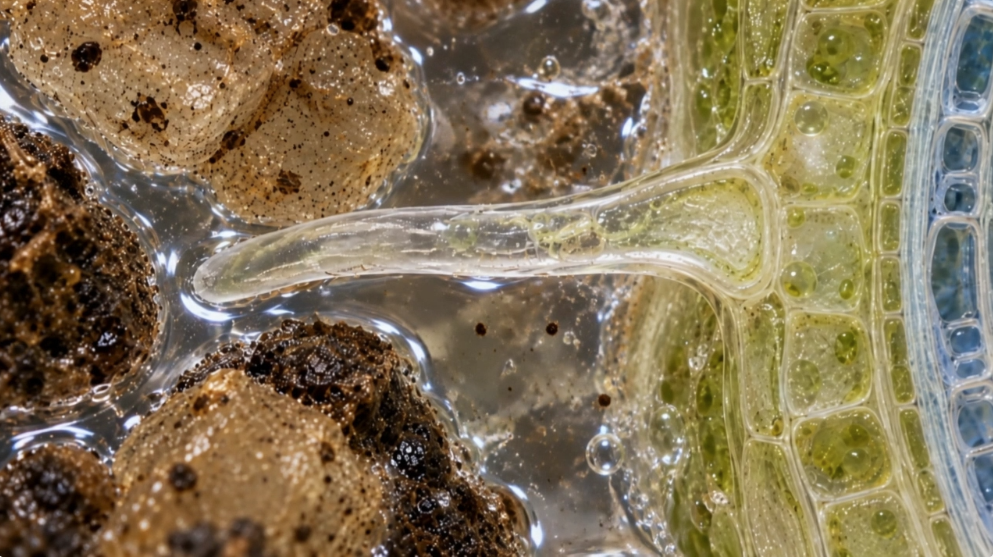
Fine roots and microscopic root hairs provide an enormous contact area with moist soil. Water moves toward and into roots according to differences in water potential—the physical tendency of water to move from one energy state to another.
Inside the plant, much of it enters microscopic vessels called xylem and travels upward.
Tiny openings in leaves, called stomata, allow carbon dioxide to enter for photosynthesis, but water vapour also escapes through them. This loss is called transpiration.
As water evaporates from leaves, it creates tension in continuous columns of water inside the xylem. Because water molecules attract one another, water leaving the leaf helps pull more water upward from below.
The journey becomes one connected system:
Soil → Root → Xylem → Leaf → Atmosphere
Most water taken up by many plants eventually returns to the atmosphere through transpiration. This is not simply waste. Transpiration accompanies gas exchange, helps cool leaves and contributes to the movement of water and dissolved minerals through the plant.
Reading Moisture in Your Soil
The surface can be deceptive. Dry-looking soil may have adequate moisture below, while a wet surface does not mean the entire root zone is properly watered.
A simple check is to take soil from the active root zone and squeeze it firmly. Appropriately moist soil generally feels cool and moist and forms some kind of ball or clump without releasing free water.
The result depends on soil type. Sandy soil may only weakly hold together. Loam usually forms a ball that breaks apart reasonably easily. Clay forms a firmer ball and becomes sticky when excessively wet.
A farmer should therefore learn how his own soil behaves rather than relying only on surface appearance or a fixed irrigation calendar.
Healthy Soil Makes Every Drop Count
Our earlier Knowledge Hub subjects now come together. Organic matter and compost support aggregation and biological activity. Microorganisms help develop soil structure. Earthworm channels provide pathways for water and air. Reduced tillage helps preserve pore networks, while living roots and cover crops protect and develop the soil.
These practices do not create water. They influence what the soil does with the water it receives.
For farmers, this also has economic value. Water that runs off, is applied unnecessarily, or carries nutrients below the root zone means lost resources, pumping energy, labour and money.
The objective is therefore neither maximum irrigation nor maximum water retention.
It is the right amount of water, available around healthy roots, while the soil continues to breathe.
That is when every drop begins to count.