 English
 اردو
What Can Agriculture Learn from Forests?
Thought to Ponder
“Nature has been growing plants for millions of years without ever using a plough.”
Introduction
For thousands of years, preparing land for crops has meant disturbing the soil.
Early farmers used digging sticks and hoes. Animal-drawn ploughs allowed larger areas to be cultivated, while tractors eventually made land preparation faster and more frequent. The plough helped control weeds, prepare seedbeds, incorporate manure and residues, and became almost inseparable from the idea of good farming.
Yet our growing understanding of soil raises an interesting question:
Who ploughs the forest?
No tractor turns the forest floor, yet forests can remain productive for centuries.
The question is not whether the plough has been useful. It clearly has.
The question is whether soil needs to be repeatedly disturbed to remain productive—or whether agriculture can learn from nature.
When Tillage Becomes Too Much
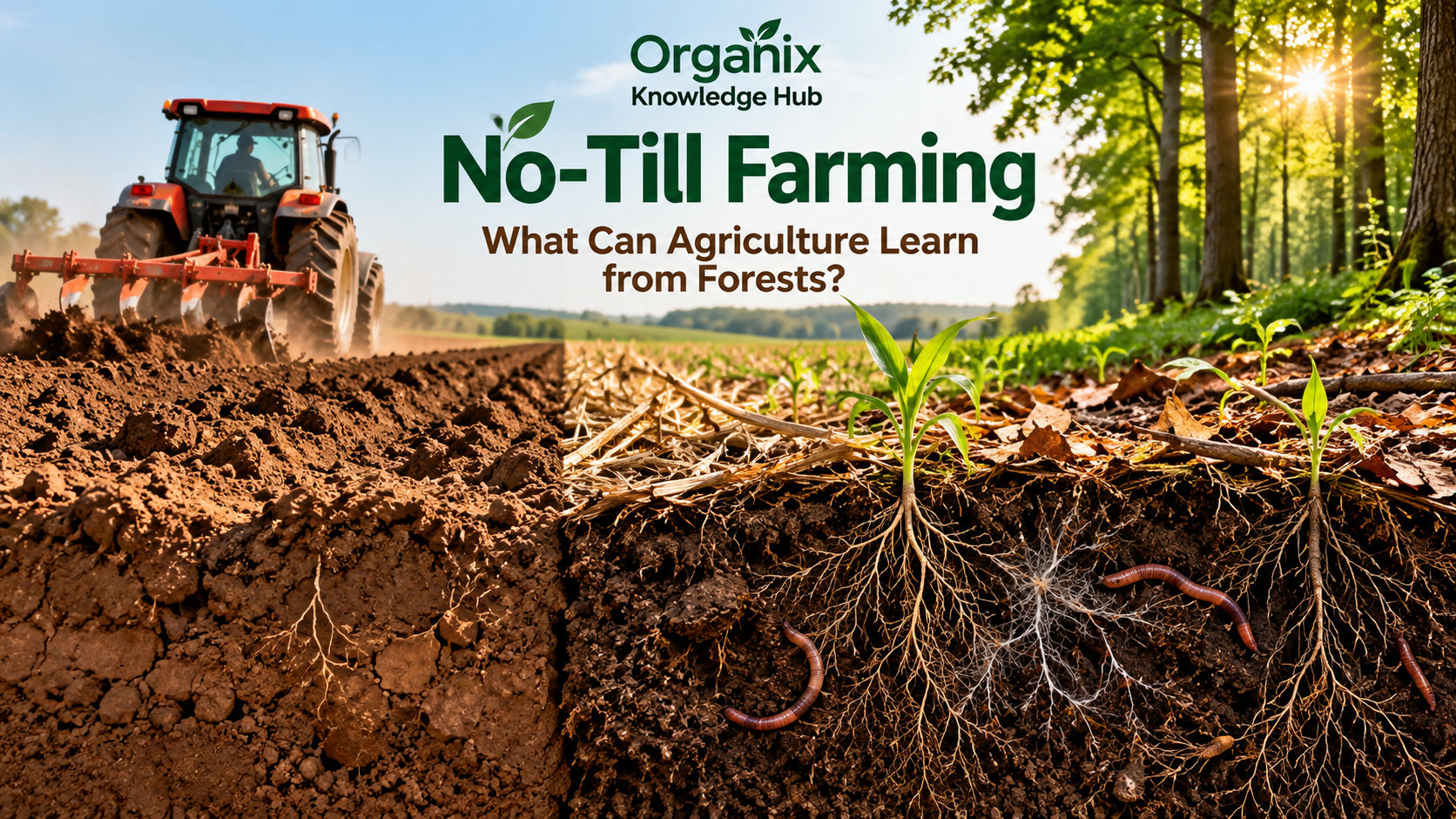
Ploughing produces an immediate result. Hard ground becomes loose, weeds disappear and the field appears ready for planting.
But mechanically loosened soil and naturally structured soil are different.
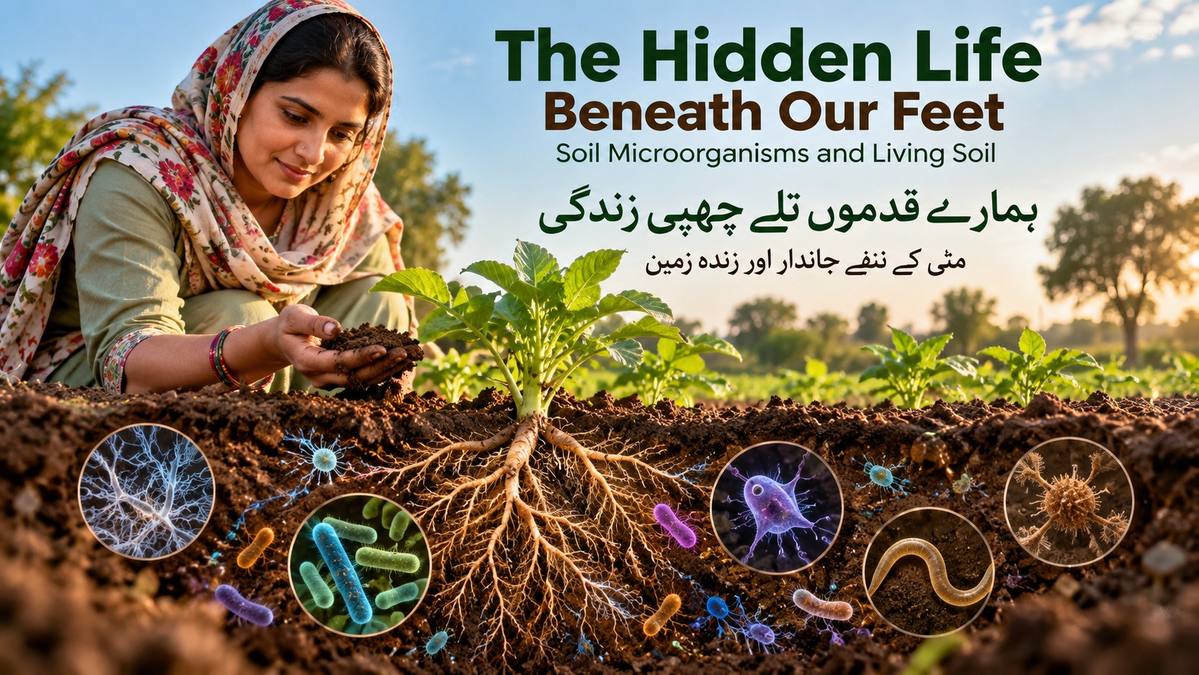
As discussed in The Hidden Life of Soil, healthy soil contains aggregates, pores and biological channels created and maintained by roots and soil organisms. Repeated intensive tillage can damage this structure, disrupt biological activity and accelerate organic matter loss.
The soil may initially appear soft, yet repeated disturbance can make it more vulnerable to compaction, erosion and moisture loss.
The plough loosens soil temporarily. Living soil builds structure continuously.
How Does Nature Manage Without Tillage?
Natural ecosystems maintain soil differently.
Roots create pathways for air and water. Plant material protects the surface and is gradually recycled. Biological activity continually helps maintain soil structure.
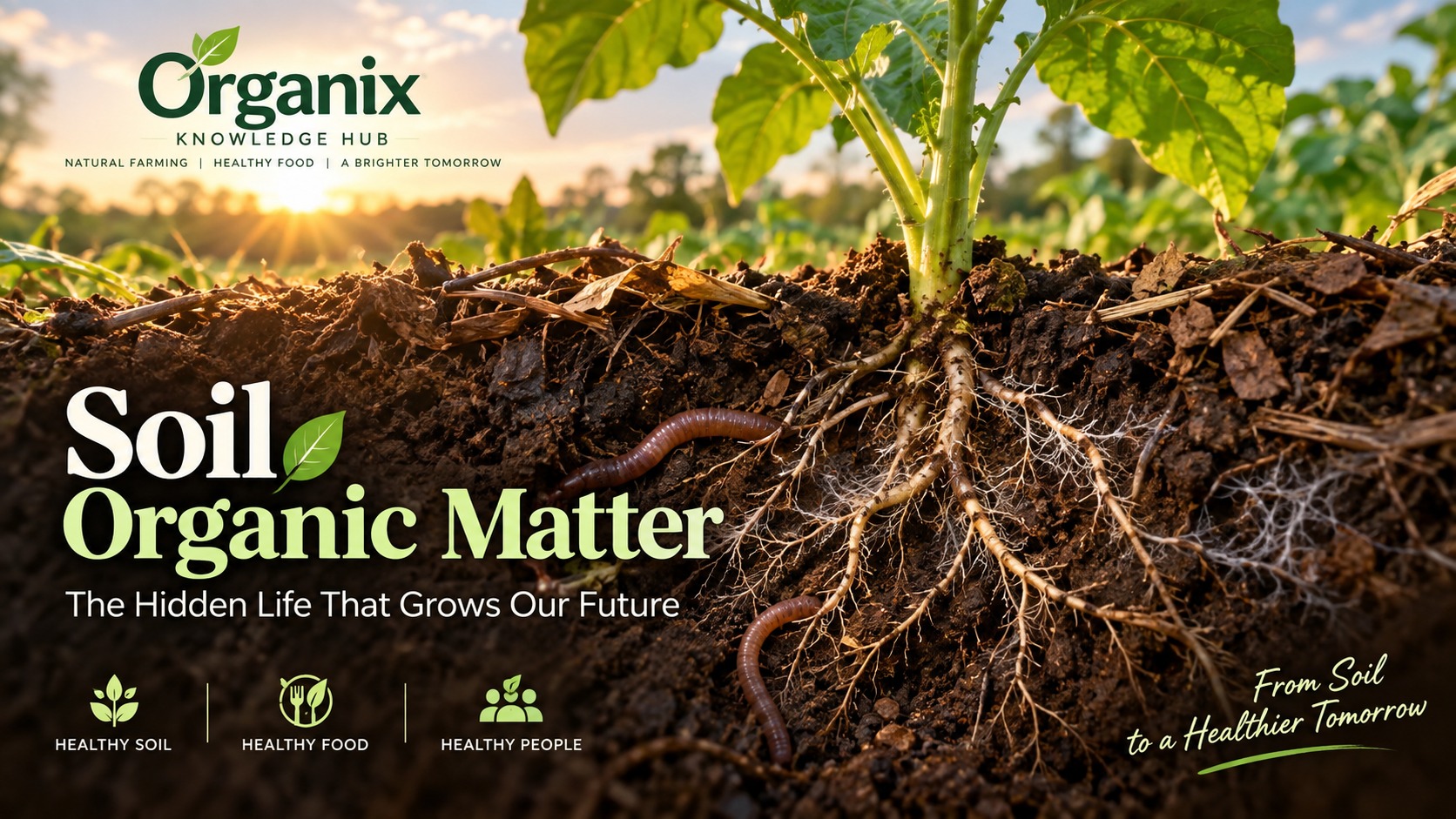
We have already explored these processes in The Hidden Life of Soil and Soil Organic Matter. The lesson relevant here is straightforward:
Nature builds soil by protecting and feeding it while disturbing it as little as possible.
This principle lies at the heart of no-till farming.
What Is No-Till Farming?
No-till means planting crops with minimum disturbance. Instead of ploughing the whole field, seeds are placed directly into narrow openings, while suitable crop residues are generally retained on the surface.
It sounds simple. Short videos and social-media discussions can sometimes make it appear to be little more than “stop ploughing, leave the residue and plant.”
In reality, successful no-till requires careful management.
Ploughing performs several functions: preparing the seedbed, controlling weeds, managing residues and temporarily loosening soil. Removing tillage does not remove these requirements. They must be managed differently.
No-till is therefore not about doing nothing. It is about reducing unnecessary disturbance while maintaining the conditions needed for a successful crop.
Crop Residues: Bury Them or Leave Them?
Crop residues are often incorporated into soil to accelerate decomposition. Mixing them with moist soil increases contact with microorganisms, so the reasoning is scientifically valid.
But decomposition is not their only function.
Residues retained on the surface can reduce evaporation, moderate soil temperature, protect against rain and erosion, and suppress some weeds. Meanwhile, biological activity gradually decomposes them and returns organic matter and nutrients to the soil.
So the choice is not between burying residue and leaving it untouched. It is about how and where decomposition takes place.
In no-till farming, surface residues can perform two functions:
First they protect the soil. Then they feed it.
Neither approach should become a rigid rule. Crop type, disease risk, climate and planting requirements matter. In Pakistan, residues may also be valuable as livestock fodder.
The important point is to understand the purpose of the practice before choosing it.
The Weed Challenge
Weeds are one of the greatest challenges in no-till farming.
Ploughing traditionally provides effective weed control. When it is removed, another method must take its place. Many conventional no-till systems rely on herbicides, which is why no-till is not automatically organic.
Nature-based systems may instead combine mulch, crop residues, crop rotation, competitive crops and cover crops—the latter being the subject of a forthcoming Organix Knowledge Paper.
This highlights perhaps the most important practical lesson:
Removing the plough is not enough. Its functions must be replaced intelligently.
The Organix objective is therefore not simply no-till, but reducing unnecessary disturbance while strengthening the natural processes that maintain healthy soil.
No-Till in Pakistan: Does It Make Economic Sense?
Pakistan already has practical experience with zero-tillage, particularly in rice–wheat systems where wheat can be planted after rice with considerably less land preparation. Residue-handling seeders can also plant while retaining rice residue on the surface.
The attraction is economic as well as environmental.
Every tractor pass requires diesel, labour, machinery and time. Fewer cultivation passes can reduce land-preparation costs and allow earlier planting. Surface residues may also conserve moisture under suitable conditions.
But no-till has challenges. Appropriate equipment may be required, weeds need different management, and residues often have competing uses—particularly as livestock fodder.
Nor will one method suit Pakistan's diverse farming systems.
For many farmers, reduced tillage may therefore be a more practical starting point than complete no-till.
The principle matters more than the label:
Disturb only as much soil as necessary.
Conclusion
The plough has served agriculture for thousands of years and will continue to have a role.
But understanding soil as a living system changes how we think about cultivation.
No-till should not become another agricultural slogan. Simply stopping ploughing does not automatically create healthy soil. Planting, weeds, residues and soil condition still require careful management.
Nor should we declare war on the plough.
Sometimes cultivation is necessary. Sometimes reduced tillage is enough. Under suitable conditions, complete no-till may work extremely well.
The objective is to understand when disturbance helps—and when it becomes unnecessary.
Nature shows that productive soil can maintain much of its structure without repeated mechanical cultivation. Agriculture cannot become a forest, but it can learn from that principle.
Perhaps the future of cultivation is not about finding better ways to disturb the soil.
Perhaps it is about learning when not to disturb it.
Key Takeaways
- Repeated intensive tillage can weaken natural soil structure.
- No-till means minimizing unnecessary disturbance, not abandoning management.
- Surface residues can protect soil before gradually feeding it through decomposition.
- No-till is not automatically organic; weed management remains a major challenge.
- Pakistan already has practical experience with zero-tillage, particularly in rice–wheat systems.
- For many farmers, reduced tillage may be a practical step towards healthier soil.
Organix Insight
Good farming is not measured by how often we work the soil, but by how well the soil can work for itself.
References and Further Reading
Food and Agriculture Organization of the United Nations. Resources on Conservation Agriculture and sustainable soil management.
United States Department of Agriculture, Natural Resources Conservation Service. Resources on soil health, no-till and residue management.
International Maize and Wheat Improvement Center (CIMMYT). Research on conservation agriculture and zero tillage in Pakistan and South Asia.
Pakistan Agricultural Research Council. Research relating to conservation agriculture and sustainable soil management.
About Organix Knowledge Hub
The Organix Knowledge Hub shares reliable, science-based knowledge to promote sustainable agriculture, environmental conservation and informed living.
Learn from Nature. Grow with Nature.